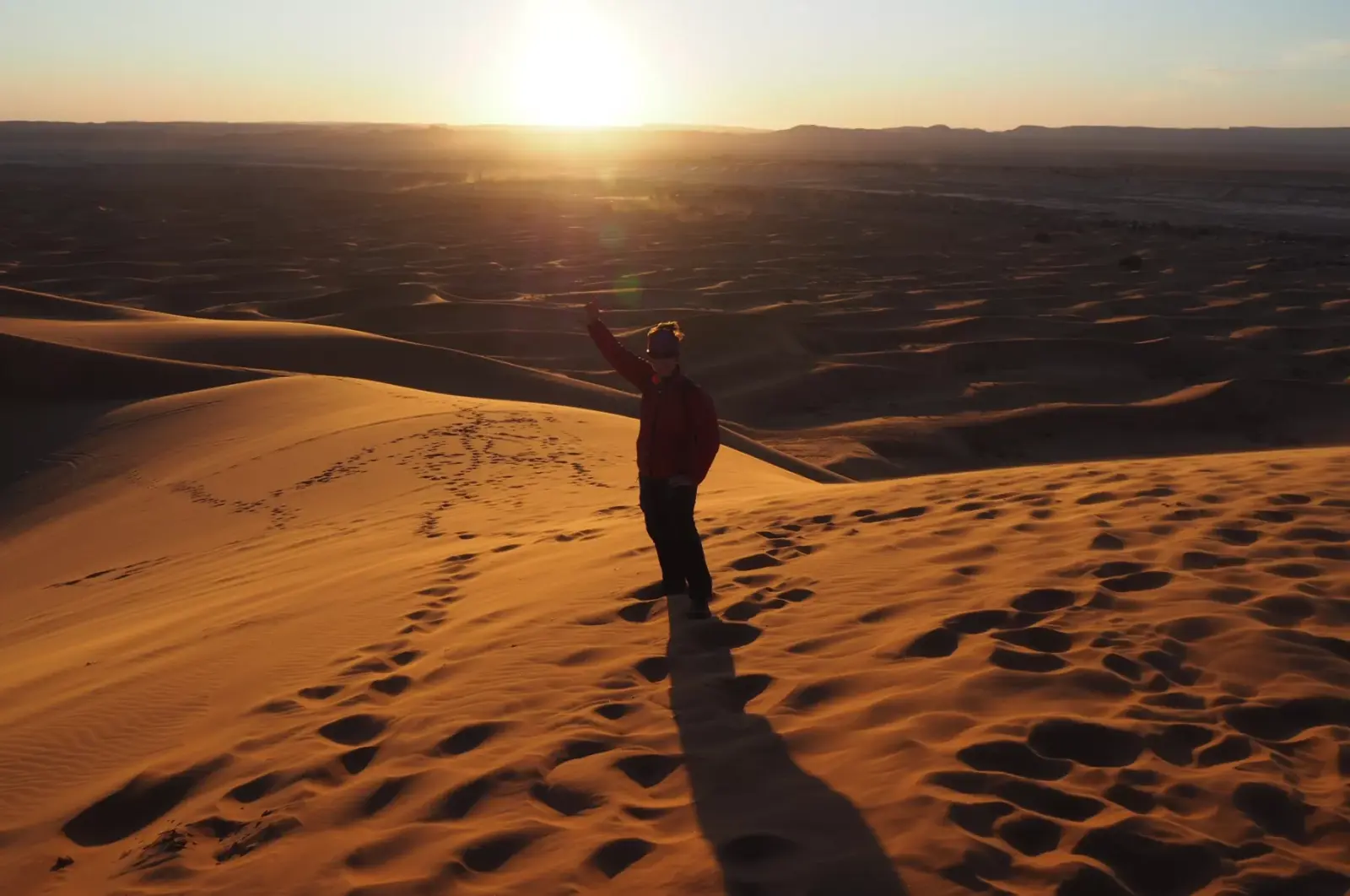
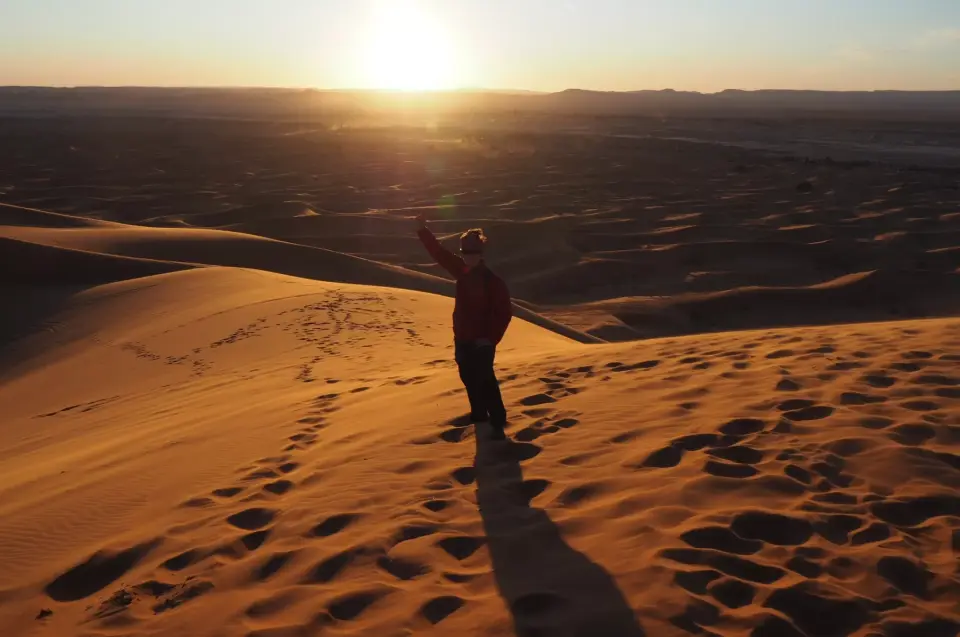
This four-day trek is built around a simple idea: the desert is better understood when the landscape changes gradually beneath your feet. Starting around M’Hamid El Ghizlane, the route moves away from the oasis edge into increasingly open country, passing tamarisk areas and Sidi Naji before reaching smaller dune fields, dry-lake terrain and finally Erg Zahar.
The trip includes two principal trekking days of about 3½ to 4 hours of walking. That makes it a practical introduction to multi-day Sahara trekking for travelers who are comfortable walking on natural desert terrain but do not want a long expedition.
The route is not presented as an endless sea of sand. Its value is the progression: palms and sparse vegetation near M’Hamid, wider horizons around Sidi Naji, firmer open ground and dry-lake landscapes, then the larger dune forms around Erg Zahar. Reaching the dunes on foot gives a stronger sense of distance and scale than arriving directly by vehicle.
The final return from the Erg Zahar area is by 4×4 rather than retracing the complete walking route. Exact meals, luggage support, tent configuration, pickup arrangements and pricing are confirmed in the DesertBrise proposal before booking.
Itinerary
Day 1
M’Hamid: From the Draa Valley to the Desert Edge
M’Hamid El Ghizlane marks the point where the settled landscapes of the Draa Valley open toward the Sahara. The first day is intentionally lighter than the walking stages that follow, giving you time to arrive in the area and shift from road travel to the rhythm of a desert trek.
The surroundings still carry signs of oasis life: palms, earthen settlement patterns and the last cultivated ground before the landscape becomes much more open. This transition matters because the following two days make sense only when you feel the desert growing around you rather than appearing suddenly from a vehicle.
Your exact arrival point, pickup arrangement and first-night setup are confirmed in the DesertBrise proposal for your departure. The walking route begins the following day.
Day 2
M’Hamid to Sidi Naji: Leaving the Oasis Behind
The first full walking stage leaves the M’Hamid area and gradually moves beyond the palm-grove edge. Vegetation becomes thinner, with tamarisk trees appearing in places before the trail opens into broader desert terrain.
The day's rhythm is deliberately simple. Walk during the cooler hours, stop around the middle of the day where shade and conditions allow, then continue when the light and temperature are more comfortable. The source route places the approach to Sidi Naji on this stage, after the palm-grove and tamarisk landscapes.
Sidi Naji is connected in local oral tradition with stories carried through this part of the Sahara. We treat those accounts as living local memory rather than turning them into invented historical certainty.
By the end of the walk, the oasis feels distant and the horizon has widened. The night is spent in a desert bivouac on the route.
Day 3
Sidi Naji to Erg Zahar: Dunes, Dry Lake and Open Sahara
The second principal trekking day shows how varied the Sahara can be over a relatively short distance. Leaving the Sidi Naji area, the route crosses smaller dunes before opening onto flatter terrain associated with a dry lake.
That contrast is one of the reasons to walk this route. Sand gives way to firmer open ground, then the dune horizon begins to build again. Erg Zahar becomes the day's natural destination rather than simply another stop on a driving circuit.
Approaching on foot changes the experience of the dunes. They first sit far away on the horizon and gradually gain scale as you move closer. The final desert night is spent in the Erg Zahar area, with the exact bivouac setup confirmed for your departure.
Day 4
Erg Zahar to M’Hamid: Return by 4×4
The last morning begins in the desert before the route turns back toward M’Hamid. Instead of repeating the complete walking trail in reverse, the return from the Erg Zahar area is made by 4×4.
This creates a genuine point-to-point feeling to the trek: you have walked progressively deeper into the Sahara, then leave by a different mode of travel. As the vehicle approaches M’Hamid, the transition reverses and signs of oasis life begin to return.
Your onward transfer or additional Morocco itinerary depends on the arrangements confirmed with DesertBrise for your trip.
Is this a four-day trip or two-day trek?
The complete product is four days and three nights. The two principal walking stages are Days 2 and 3; Day 1 is the arrival and desert transition, while Day 4 returns from the Erg Zahar area by 4×4.
How much walking is involved?
Plan on approximately 3½ to 4 hours of walking on each of the two main trekking days. Conditions, weather and the pace of the group can affect the exact time.
What is the difficulty level?
The route is designed as an easy-to-intermediate introduction to multi-day Sahara trekking. You should still be comfortable walking for several hours on sand and uneven natural ground.
Where does the trek start and finish?
The trekking area is based around M’Hamid El Ghizlane. The walking route heads toward Sidi Naji and Erg Zahar, then returns from the Erg Zahar area to M’Hamid by 4×4.
Is the whole route on sand dunes?
No. One of the strengths of the route is its variety: oasis-edge landscapes, tamarisk areas, open desert, smaller dunes, dry-lake terrain and the larger dunes around Erg Zahar.
Is this mainly a camel tour?
No. This page is built as a walking trek. Any camel or luggage-support arrangement is confirmed separately in your DesertBrise proposal rather than assumed on the page.
What kind of accommodation is used?
Desert bivouac nights are part of the trekking concept. The exact tent, bedding and comfort setup is confirmed for your departure before booking.
What should I bring?
Comfortable walking footwear, sun protection, layered clothing for temperature changes and a small day bag are sensible basics. DesertBrise will confirm the final packing list for the season and trek setup.
What's Included
No inclusion details available for this journey yet.