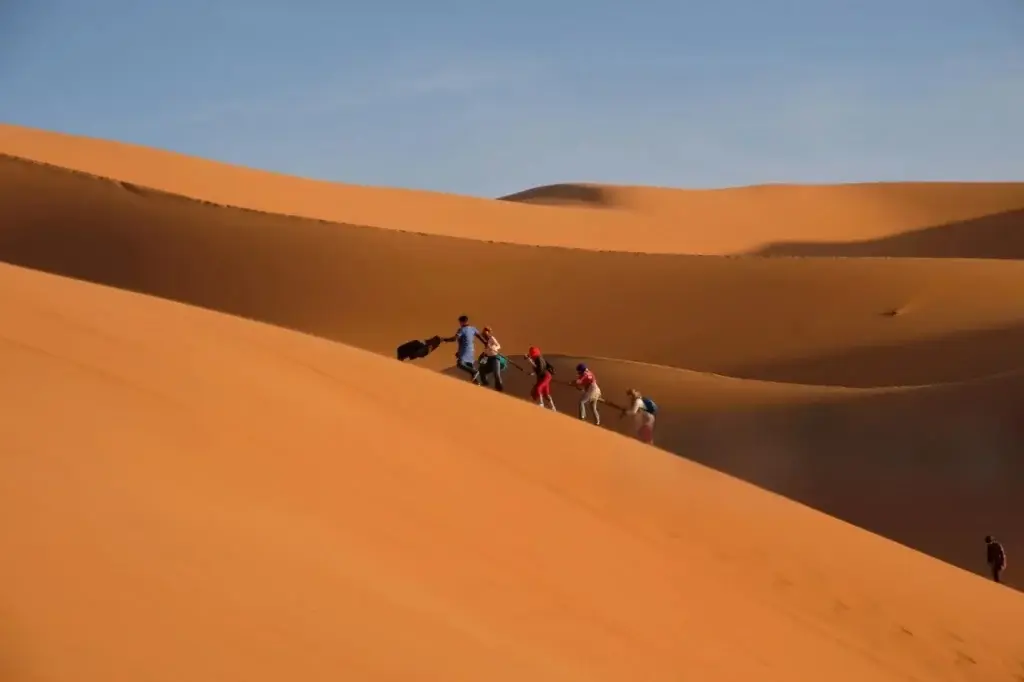
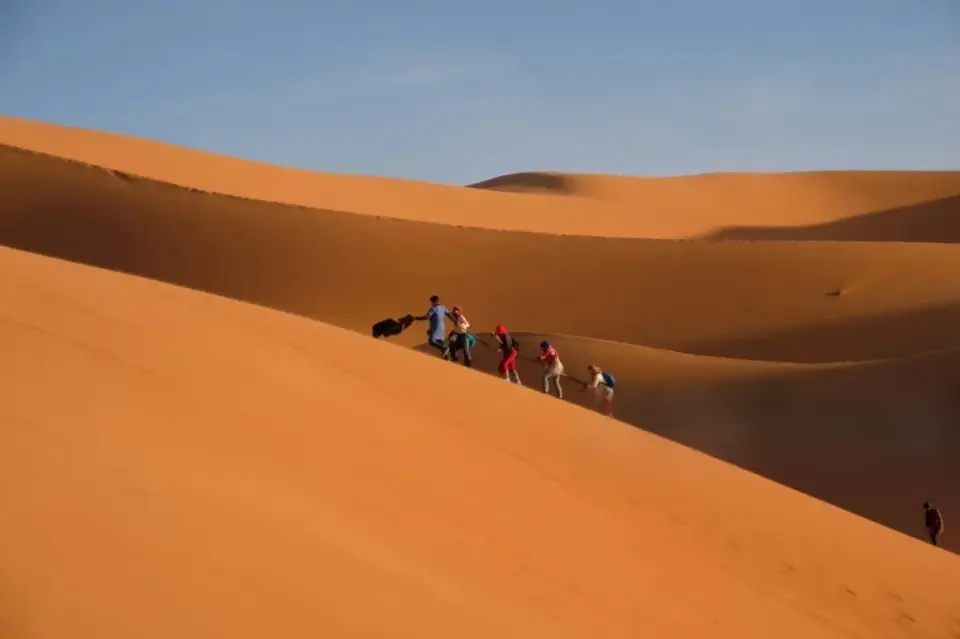
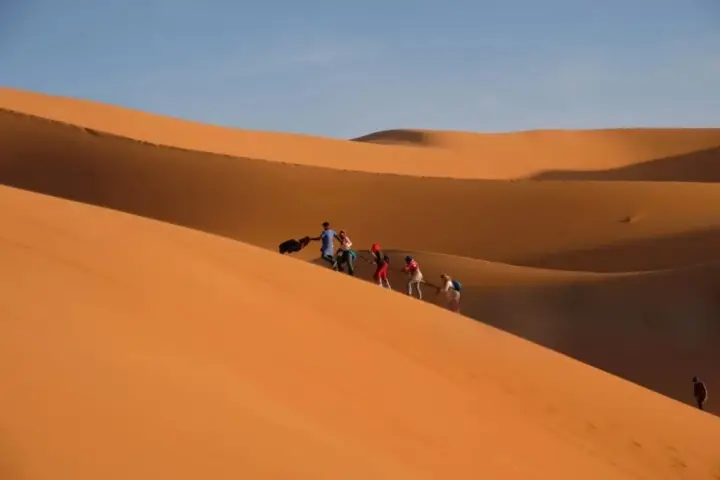
This four-day trek is for travelers who want a short Sahara journey with real walking at its center. Instead of driving directly to Erg Chegaga, you reach the dune massif step by step from M’Hamid, crossing smaller ergs, open reg and increasingly remote desert terrain.
The route includes three walking days. The first stage is shorter, around 3 to 3½ hours, while the following two stages are more substantial at roughly 5 to 5½ hours each. The progression is the point of the journey: M’Hamid falls behind, Erg Lbour introduces the first dune landscapes, Bougarn brings wider open terrain, and Erg Chegaga becomes the final walking destination.
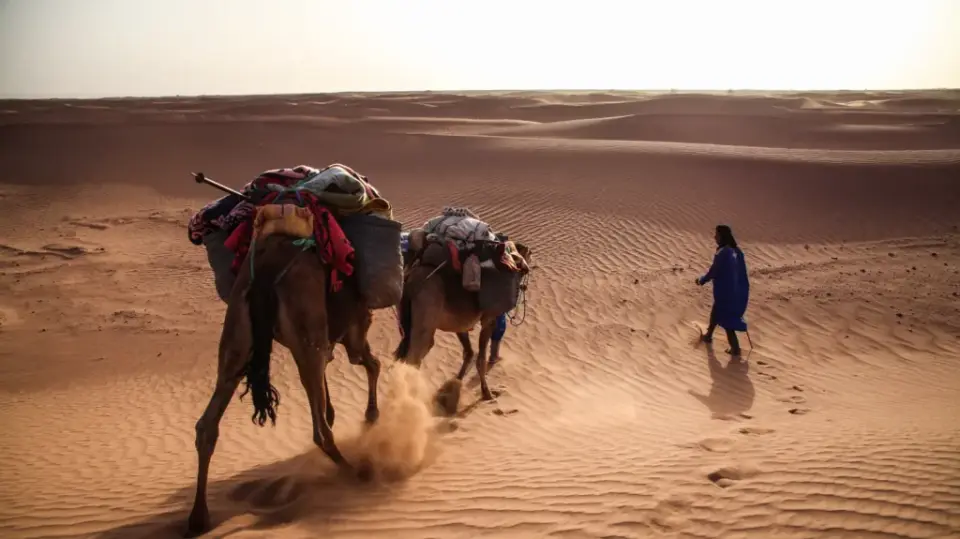
Pack dromedaries accompany the trekking team and carry personal luggage and camp equipment. Travelers normally walk with a light day bag, leaving the heavier logistics to the caravan.
This is an intermediate-to-active trek rather than a soft desert excursion. It suits travelers who are comfortable walking several hours on sand, reg and uneven natural terrain and who value simple nights in the desert.
On the final morning, the route leaves Erg Chegaga by 4×4. The return to M’Hamid covers roughly 60 km of desert track, allowing you to see in a few hours how far the walking journey has carried you.
Private departures and shared group departures are available. Exact dates, group places, camp configuration, meals, pricing and onward transfers are confirmed in your DesertBrise proposal before booking.
Itinerary
Day 1
M’Hamid to Erg Lbour: The First Steps into the Sahara
The trek begins from the M’Hamid area, where the last traces of oasis life gradually give way to open desert. Rather than using a vehicle to reach the deeper dunes, the route starts on foot and lets the transition happen naturally.
The first stage is shorter than the days that follow, usually around 3 to 3½ hours of walking. Tamarisk, low dune formations and widening horizons shape the route toward Erg Lbour.
Pack dromedaries travel with the trekking team, carrying the main luggage and bivouac equipment while you keep only what you need during the day.
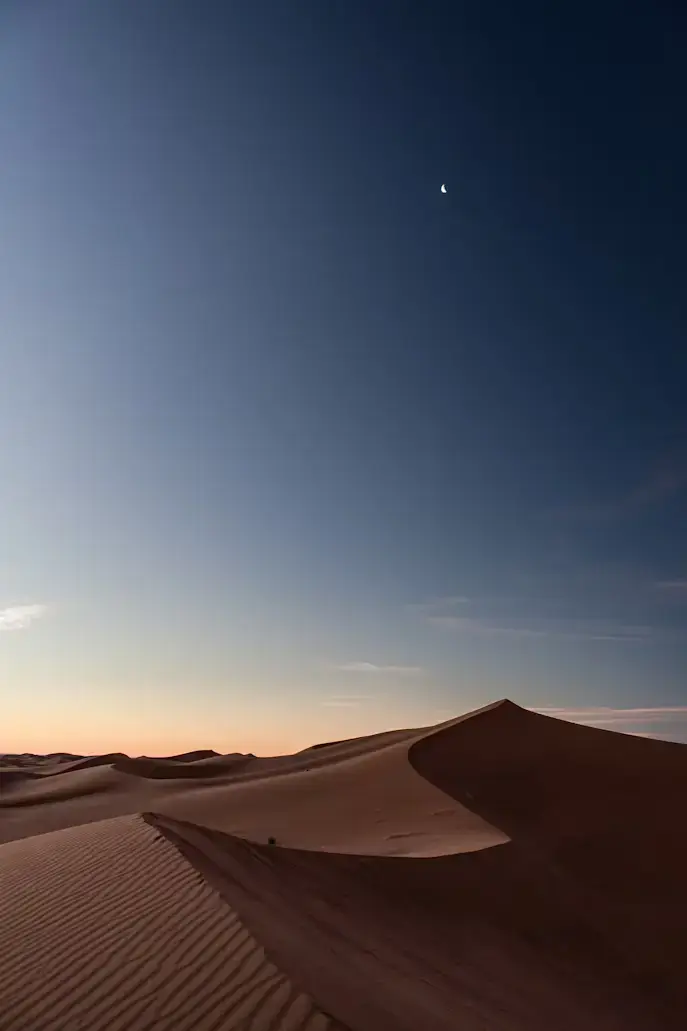
Depending on season, arrival timing and the team’s assessment, part of this first stage may take place toward sunset or after dark. When that happens, a headlamp becomes part of the experience rather than a gimmick: the desert feels larger when landmarks disappear and the caravan follows the route under the night sky.
The first desert camp is established in the Erg Lbour area.
Day 2
Erg Lbour to Bougarn: A Longer Day across Reg and Dunes
Today the trek becomes more demanding. Leaving Erg Lbour, the route alternates between smaller dune systems and broad stretches of reg, where the firm, stony ground creates a very different walking rhythm from soft sand.
This is a substantial stage of roughly 5 to 5½ hours on foot. The variety of terrain matters: progress feels quicker on the harder surfaces, then slows again where the route returns to sand and dune corridors.
The caravan keeps its own steady rhythm beside the group, with the dromedaries carrying camp gear and personal luggage. Midday is used for food and rest according to conditions before the trek resumes toward Bougarn.
By late afternoon, the landscape feels noticeably more remote than it did around M’Hamid. Camp is made in the Bougarn area for the second night in the desert.
Day 3
Bougarn to Erg Chegaga: Reaching the Great Dune Massif on Foot
The third walking day gives the trek its natural climax: Erg Chegaga.
From Bougarn, the route continues for roughly 5 to 5½ hours as the dune systems grow broader and more imposing. What makes the day memorable is not simply arriving at Chegaga, but watching the scale of the landscape change during the approach.
The large dune massif remains distant at first. Hour by hour it becomes more present, until the route enters the Erg Chegaga area itself. Arriving this way gives a sense of distance that is easy to lose when the same ground is crossed directly by vehicle.
The final desert night is spent in the Erg Chegaga area. The exact bivouac or camp standard is confirmed for your departure, leaving the itinerary honest about what is included rather than borrowing another operator’s accommodation promises.
Day 4
Erg Chegaga to M’Hamid: Across the Desert by 4×4
The last morning begins among the dunes of Erg Chegaga before the journey changes pace completely.
A 4×4 collects the group for the return to M’Hamid across approximately 60 km of desert track. The drive takes you through a different mix of reg, hamada and open desert, showing how quickly a vehicle covers terrain that took several days to approach on foot.
The contrast is part of the experience. For three days, distance was measured by walking rhythm, rests and the movement of the caravan. On the return, the same Sahara opens at vehicle speed.
Arrival in M’Hamid closes the trek. Any onward transfer to Zagora, Ouarzazate, Marrakech, Agadir or another destination is arranged according to the confirmed DesertBrise program.
How difficult is this Erg Chegaga trek?
It is an intermediate-to-active trek. Day 1 is around 3–3½ hours of walking, while Days 2 and 3 are roughly 5–5½ hours. You should be comfortable walking for several hours on sand, reg and uneven desert terrain.
Is this the same as a 4×4 trip to Erg Chegaga?
No. The main reason to choose this itinerary is to reach Erg Chegaga on foot. The 4×4 is used for the return to M’Hamid on Day 4 rather than for the outward journey.
What do the dromedaries carry?
Pack dromedaries carry the principal luggage and bivouac equipment. Travelers normally walk with a small day bag. Any riding arrangement should be requested separately.
Can I book privately or join a shared departure?
Both formats are possible. Private departures are arranged for your own party, while shared departures allow you to join other travelers when places are available. Dates and places are confirmed on request.
Where does the trek start?
The walking route starts in the M’Hamid El Ghizlane area and progresses through Erg Lbour and Bougarn before reaching Erg Chegaga.
Where do we sleep?
The itinerary uses desert bivouac or camp nights along the route. The exact tent type, bedding, washing facilities and comfort standard are confirmed before booking.
Could we walk after dark on Day 1?
It is possible depending on season, your arrival time and the trekking team’s assessment. If the first stage extends after sunset, a headlamp is required. It is not guaranteed on every departure.
How do we return from Erg Chegaga?
The final return is by 4×4 across roughly 60 km of desert track to M’Hamid, rather than retracing the complete route on foot.
What's Included
No inclusion details available for this journey yet.