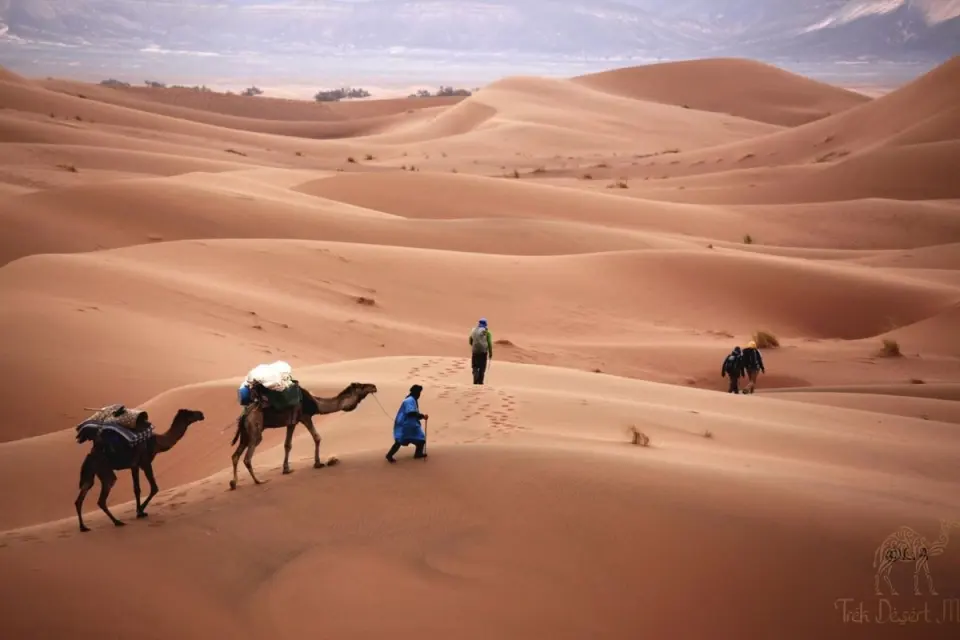
A ten-day journey can connect Morocco's imperial history with the Sahara without turning every day into a race. The route below starts in Casablanca and finishes in Marrakech, using Chefchaouen and Fes in the north before crossing the Middle Atlas to Merzouga, then returning west through the valleys and kasbahs of the south.
This is the order we use when travelers want both the major cities and a proper desert night. It avoids driving to the dunes and back along the same road, and it gives Fes, the Sahara and Marrakech enough space to feel different from one another.
10-day Morocco route at a glance
- Day 1: Casablanca to Rabat
- Day 2: Rabat to Chefchaouen
- Day 3: Chefchaouen to Fes via Volubilis and Meknes
- Day 4: Fes with a local guide
- Day 5: Fes to Midelt through the Middle Atlas
- Day 6: Midelt to Merzouga and an Erg Chebbi camp
- Day 7: Merzouga to Todra Gorge and the Dades Valley
- Day 8: Dades to Ouarzazate via the Rose Valley and Skoura
- Day 9: Ouarzazate to Marrakech via Aït Ben Haddou
- Day 10: Marrakech and departure or an extra night
Day 1 — Casablanca to Rabat: Morocco's modern gateway
If your flight arrives early enough, begin at the Hassan II Mosque, where Casablanca meets the Atlantic. The building is impressive, but the coastal setting matters just as much: fishing boats, sea spray and the long corniche give a first look at Morocco beyond the airport.
Rabat is roughly an hour and a half away in normal traffic. It is calmer than Casablanca and makes an easy first night. Walk around the Hassan Tower and the Mausoleum of Mohammed V, then enter the blue-and-white lanes of the Kasbah of the Udayas before sunset. Staying in Rabat also prevents the first day from becoming an exhausting drive north.
Day 2 — Rabat to Chefchaouen: from the Atlantic to the Rif
The road turns inland through farmland before climbing into the Rif Mountains. Chefchaouen appears in a fold of the hills rather than on a flat plain, which is why its streets rise and fall so sharply.
Arrive with time to explore after the day visitors begin to leave. The medina is compact; the pleasure is not rushing between landmarks but noticing painted doorways, communal ovens and the small streams that once supplied the town. For a wider view, walk toward the Spanish Mosque in the late afternoon. The path is straightforward, but shoes with grip are useful.
Day 3 — Chefchaouen to Fes via Volubilis and Meknes
Leave after breakfast for Volubilis. The Roman site is exposed, so morning light and cooler temperatures make the visit more comfortable. A local guide can explain the mosaics and the agricultural wealth that supported the settlement; without context, the ruins can feel like disconnected columns.
Continue through Meknes for Bab Mansour and the old imperial quarter, then reach Fes in the evening. Ask the driver to use the riad's closest accessible gate. Cars do not enter much of Fes el-Bali, and carrying luggage through unfamiliar alleys after dark is an avoidable first impression.
Day 4 — Fes: a full day inside the living medina
Fes deserves a complete day with a licensed local guide. Start from a viewpoint above the medina to understand its scale, then enter on foot through the craft quarters. The tanneries are only one part of the story. Brass workshops, cedar carving, food markets, Quranic schools and neighborhood fountains show how the city still functions from within.
A good visit leaves room for lunch and conversation instead of treating the medina as a checklist. Wear comfortable shoes and keep the evening free. After several hours in narrow lanes, a quiet riad courtyard is part of the experience.
Day 5 — Fes to Midelt: cedar forests and the Middle Atlas
This is the transition day between northern Morocco and the pre-Sahara. The road climbs through Ifrane and the cedar country near Azrou. Barbary macaques are often seen near the forest, but feeding them changes their behavior and should be avoided.
Continue across open plateaus toward Midelt, with the Middle and High Atlas ranges framing the route. Sleeping in Midelt divides the long journey to Merzouga. It also means the following day reaches the desert with time for the camel ride rather than arriving after sunset.
Day 6 — Midelt to Merzouga: the Ziz Valley and Erg Chebbi
The landscape changes quickly beyond the mountains. Follow the Ziz Valley past palm groves, fortified villages and dry cliffs toward Erfoud and Rissani. These are not decorative stops: the valley explains how settlements survive along watercourses in an otherwise harsh region.
At Merzouga, leave large luggage at the meeting point and carry only what you need overnight. The camel ride normally starts in the later afternoon when the sand is cooler. A 4×4 transfer is a practical alternative for anyone who does not want to ride. At camp, allow the sunset and night sky to be the main event; loud entertainment and vehicles should not replace the quiet that people travel this far to experience.
Day 7 — Merzouga to Todra Gorge and the Dades Valley
After sunrise and breakfast, return from the dunes and travel west. Rissani's market is worthwhile on market days, especially for dates, spices and the covered livestock area, but timing should remain flexible.
Walk beneath the high walls of Todra Gorge, then continue through Tinghir's palm oasis toward the Dades Valley. The final road rises through sculpted rock formations and old villages. An overnight stay here is more comfortable than pushing all the way to Marrakech and gives the southern landscape its own day.
Day 8 — Dades to Ouarzazate via the Rose Valley and Skoura
Follow the Valley of Roses toward Kelaat M'Gouna. The rose harvest is seasonal—usually spring—so outside that period the valley should be appreciated for its villages and agriculture rather than promised as a field of flowers.
At Skoura, palm groves conceal earthen kasbahs and working farms. A short guided walk reveals irrigation channels and family compounds that are easy to miss from the main road. Continue to Ouarzazate for the night. Film studios are optional; the region's architecture and desert-edge geography are the stronger reasons to stop.
Day 9 — Ouarzazate to Marrakech via Aït Ben Haddou
Visit Aït Ben Haddou before the busiest part of the day. Cross into the ksar and climb gradually through its earthen lanes. Families still have connections to the village, so it should be treated as more than a film set.
The drive to Marrakech crosses the High Atlas by the Tizi n'Tichka road. Weather, construction and traffic can change the timing, so avoid scheduling a fixed evening activity immediately after arrival. Once in Marrakech, settle into the riad and take an unhurried first walk toward Jemaa el-Fna.
Day 10 — Marrakech: palaces, souks and a sensible finish
Use the final day for Marrakech with a local guide: the Bahia Palace area, historic neighborhoods, artisan souks and the changing rhythm around Jemaa el-Fna. Choose a few places and understand them rather than crossing the medina repeatedly for photographs.
If your flight leaves early, move the guided visit to Day 9 only when arrival time allows. For an afternoon or evening departure, arrange the airport transfer with enough margin for traffic. Travelers with another night can add a hammam, a cooking experience or the Majorelle area without compressing the old city visit.
Is ten days enough for this route?
Ten days is the practical minimum for this north-to-south circuit. It works because the journey is linear and because the long Fes-to-Sahara distance is divided in Midelt. It is not a slow trip: there are several hotel changes and two substantial mountain crossings.
With twelve days, add a second night in Chefchaouen or Merzouga and a second full day in Marrakech. With only eight days, remove Chefchaouen or the Sahara instead of trying to shorten every stop.
Private driver or self-drive?
A self-drive trip is possible, but a private driver reduces fatigue on the mountain roads and solves practical issues such as medina drop-off points, desert meeting locations and route changes after bad weather. The driver is not automatically a licensed city guide; separate local guides are the better choice in Fes, Marrakech and Volubilis.
For more route options, explore our private Morocco tours, read our three-day Marrakech itinerary, or ask our Morocco-based team to adapt this journey to your arrival city and pace.