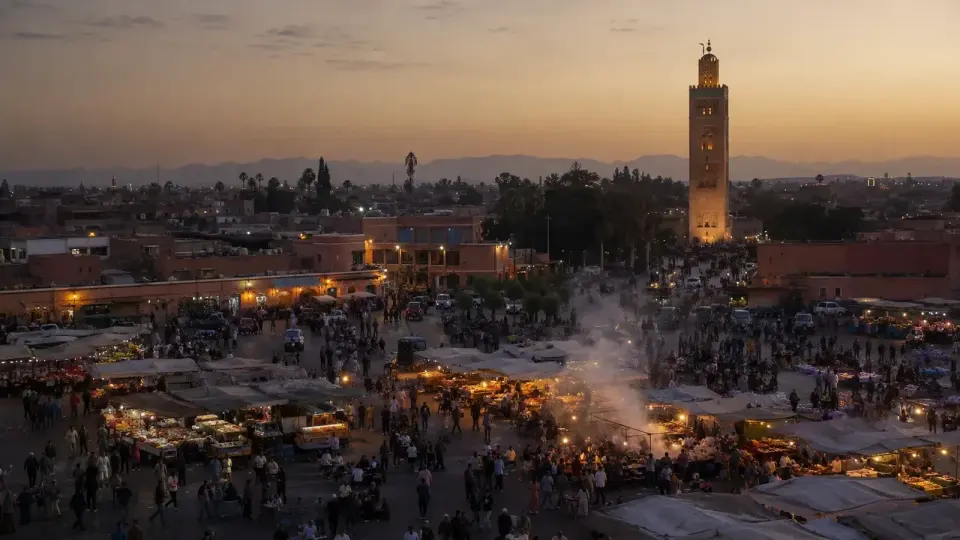
Marrakech Is a Gateway, Not Just a City
Many travelers think of Marrakech as a destination. That is true, but from real local experience, Marrakech is also something bigger: it is one of the main gateways into Morocco.
For many visitors, the journey begins here. They land at Marrakech Menara Airport, step into the warm air, see palm trees, red walls, taxis, city traffic and the first signs of Moroccan life. Some travelers go directly to a riad in the medina. Others continue later toward the Atlas Mountains, the desert, the coast or the imperial cities.
Marrakech connects many different Morocco experiences. From Marrakech, you can go toward the High Atlas Mountains. You can continue to Ait Ben Haddou and Ouarzazate. You can follow the Draa Valley toward Zagora and M’Hamid. You can reach Erg Chigaga for a deeper Sahara journey. You can travel toward Merzouga and Erg Chebbi. You can go west to Essaouira and the Atlantic coast. You can continue north toward Casablanca, Rabat, Fes or Chefchaouen.
This is why knowing how to get to Marrakech and how to move around matters. Transport is not only a practical detail. It shapes the whole feeling of the trip. A good arrival can make you feel calm. A bad arrival can make Morocco feel confusing. A good transfer can protect your energy. A badly planned route can steal the first day of your holiday.
Marrakech is powerful, beautiful and alive, but it also needs smart planning. The city can feel intense for first-time visitors, especially when they arrive tired, with luggage, after a flight, and do not know where their riad is located. This guide is written to help you arrive with confidence, move around with less stress and understand which transport choices make sense depending on your itinerary.
Because Morocco is not a checklist. And movement in Morocco is part of the journey.
The Main Ways to Get to Marrakech
There are several ways to get to Marrakech, depending on where your Morocco trip begins.
The most common way is by flying directly into Marrakech Menara Airport. This is often the easiest option for travelers who want to start in Marrakech, spend a few nights in the city, then continue toward the Atlas Mountains, Essaouira or the Sahara Desert.
Another common way is to arrive in Casablanca first. Casablanca is one of Morocco’s major international entry points, and many long-haul flights arrive there. From Casablanca, travelers can continue to Marrakech by train, private driver, coach or internal connection.
Some travelers arrive from Fes, Rabat, Tangier, Agadir or Essaouira as part of a wider itinerary. In that case, Marrakech becomes either the start, middle or end of the journey.
You can reach Marrakech by plane, train, private transfer, coach, rental car or organized private tour. Each option has advantages. Flying is usually easiest for direct international access. Train is comfortable from Casablanca, Rabat, Tangier and some northern cities. Private transfer is best for comfort, families, luggage, late arrivals or custom itineraries. Coach can work for budget travelers and routes not covered well by train. Rental car gives freedom but requires confidence with Moroccan roads and city traffic. A private tour is best when Marrakech is part of a full route through mountains, desert and coast.
The right choice depends on your full trip, not only your first day. A traveler spending only two nights in Marrakech needs one kind of transport. A traveler starting a ten-day Morocco itinerary toward the Sahara needs another. A family with children needs a different rhythm than two backpackers. A couple arriving late at night needs more comfort than someone arriving at noon with one small bag.
Transport should serve the journey. Not disturb it.
Arriving at Marrakech Menara Airport
Marrakech Menara Airport is the main airport for the city and one of the most useful arrival points for travelers who want Marrakech, the Atlas Mountains and southern Morocco.
The airport is close to Marrakech compared with many international airports, but the real arrival time depends on traffic, passport control, luggage, where you stay and whether your accommodation is inside the medina.
For first-time visitors, the most comfortable airport arrival is usually a pre-arranged transfer. This is especially true if you arrive at night, stay in the medina, travel with family, carry large luggage or do not speak French, Arabic or Moroccan Darija.
Why? Because many riads inside the medina are not directly accessible by car. A driver may take you to the nearest gate or drop-off point, then someone from the riad may need to meet you and guide you through small streets. This is normal in Marrakech, but for a first arrival it can feel confusing.
A pre-arranged transfer avoids stress. You arrive, find your driver, load your luggage and go directly toward your accommodation. If the riad is inside the medina, the transfer should include guidance to the door or coordination with the riad staff.
Airport taxis are also available. They can be useful, but travelers should agree clearly on the destination and price before entering, especially when going to a medina gate or a riad that cars cannot reach directly.
My honest advice is simple: for your first arrival in Marrakech, choose comfort over saving a small amount of money. The first hour in Morocco should feel calm, not stressful. Once you understand the city, you can use cheaper local transport more easily.
Arriving in Marrakech From Casablanca
Many international travelers arrive first in Casablanca, then continue to Marrakech. This can be a smart option if your flight connections are better through Casablanca or if your Morocco trip begins there.
From Casablanca to Marrakech, the most common options are train, private transfer, coach or domestic connection. The train is often comfortable for travelers who arrive early enough, travel light and want a simple city-to-city journey. A private transfer is smoother for travelers who arrive tired, have children, carry luggage, land late or want door-to-door service.
The train can be a good solution, but it still requires planning. You need to think about the airport arrival, luggage, possible delays, the connection to the train, the train journey itself and the final transfer from Marrakech station to your accommodation.
A private transfer from Casablanca to Marrakech costs more than public transport, but it removes many small problems: waiting, changing stations, finding the right platform, managing bags and then taking another taxi in Marrakech. For families, couples on a special trip or travelers arriving after a long flight, this comfort can be worth it.
The mistake is booking transport too tight after an international flight. Flights can arrive late. Passport control can take time. Luggage can be slow. The connection from airport to city station can add stress. Leave space. Morocco is better when the first day is not overloaded.
If Marrakech is the first chapter of a longer Morocco journey, the best transfer is the one that protects your energy for the days ahead.
Arriving by Train or Coach
Train travel in Morocco is one of the easiest ways to move between major cities. It can work well for routes such as Casablanca to Marrakech, Rabat to Marrakech, Tangier to Marrakech with connections and other city-to-city journeys.
For many travelers, arriving by train in Marrakech is simpler than arriving by coach because the train station is organized, known and easy to connect from by taxi or private transfer. The Marrakech train station is located outside the old medina, in the modern city area. From there, travelers can continue to Gueliz, Hivernage, the medina gates, hotels, riads or private tour meeting points.
Train travel is useful when you arrive in Casablanca first, want to combine Rabat and Marrakech, travel from Tangier or northern Morocco, prefer public transport but want more comfort than a bus, and have medium luggage with a clear schedule.
Coaches and buses are also useful in Morocco, especially for routes where train service is limited or less direct. From Marrakech, coach routes can be practical for Essaouira, Agadir, Ouarzazate and other destinations. For independent travelers, buses can be affordable and useful.
But train and coach travel do not solve every final step. You still need to move from the station to your accommodation. A hotel in Gueliz or Hivernage may be easy by taxi. A riad in the medina may require a drop-off near a gate, then walking. A desert tour may start from your accommodation or a meeting point.
So when booking public transport, think beyond the ticket. Think about the full arrival: city to Marrakech, station to hotel, hotel to medina and Marrakech to the next journey.
Arriving by Private Driver or Private Tour
For many travelers, the best way to arrive in Marrakech or leave Marrakech is by private driver. This is not only luxury. It is rhythm.
A private driver makes sense when Morocco is not only one city, but a full journey. If you are planning Marrakech, the High Atlas Mountains, Ait Ben Haddou, Ouarzazate, Draa Valley, M’Hamid, Erg Chigaga, Merzouga, Fes or Essaouira, a private route gives you more control over the experience.
A private driver allows flexible stops, better timing, door-to-door comfort, local explanations, photo stops without pressure, safer luggage handling, hotel and riad coordination and a calmer rhythm for families and couples.
This matters because Morocco is not only about the destination. The road itself is part of the journey. Between Marrakech and the Sahara, the road passes mountains, villages, kasbahs, valleys, palm groves and desert landscapes. If you only think of transport as getting from A to B, you lose much of the experience.
A private Morocco itinerary can turn travel days into meaningful days. You can stop in the right places, avoid rushed timing, choose better lunch stops, visit Ait Ben Haddou with enough time, reach the desert without arriving exhausted and sleep in the right place before continuing deeper.
This is especially important for desert tours. A bad desert route can become only driving. A good desert route becomes a story: from Marrakech to the Atlas, from the Atlas to kasbah land, from kasbah land to palm valleys, from palm valleys to M’Hamid, and from M’Hamid to open Sahara.
This is the difference between transport and travel.
Moving Around Marrakech: First Understand the City
Before choosing transport inside Marrakech, you need to understand the city layout.
For travelers, Marrakech has several important areas: the old medina, Jemaa el-Fna, the souks, the Koutoubia area, the Kasbah area, Gueliz, Hivernage, Majorelle Garden, Palmeraie, Menara, the train station area and the airport road.
The medina is old, dense and made for walking. Many streets are narrow. Some areas are not accessible by car. Motorbikes, carts, pedestrians, shops and local life all move together.
Gueliz is more modern, with wider roads, cafés, shops, restaurants and easier taxi access. Hivernage has hotels, restaurants and wider streets. Palmeraie is more spread out and usually needs transport. The airport and train station are outside the deep medina.
This means your transport strategy depends on where you sleep. If you stay inside the medina, you will walk more. If you stay in Gueliz, taxis are easier. If you stay in Hivernage, modern access is simpler. If you stay in Palmeraie, you need arranged transport more often. If you stay in a riad, luggage arrival matters. If you stay in a hotel with road access, arrival is easier.
Many travelers choose accommodation only by photos. This is a mistake. In Marrakech, location changes the whole feeling. A beautiful riad deep in the medina can be magical, but arrival with luggage may need guidance. A hotel outside the medina may be easier, but less atmospheric.
There is no one perfect location. There is only the right location for your rhythm.
Walking in Marrakech: The Best Way to Feel the Medina
Inside the old medina, walking is usually the best way to move. This is how Marrakech reveals itself.
You walk through narrow streets. You pass wooden doors, small shops, spices, carpets, lanterns, bakeries, riads, workshops, hammams and local life. You hear motorbikes, voices, calls to prayer, carts and the movement of the city.
At first, the medina can feel confusing. That is normal. The streets are not designed like a modern grid. Signs may not always help. Online maps can work in some areas but become less useful in narrow lanes. Sometimes the best solution is not to move fast, but to slow down.
Walking is best for Jemaa el-Fna, souks, medina streets, riad areas, the Koutoubia surroundings, traditional markets, small museums, local shops, rooftop cafés and restaurants.
But walking needs awareness. Wear comfortable shoes. Carry only what you need. Keep your phone secure. Avoid looking lost with your luggage. Ask your riad for exact arrival directions. Use known gates and landmarks. Give yourself extra time.
The medina is not something to fight. It is something to enter slowly. For first-time visitors, a local guided walk can be very helpful, not because you are unable to walk alone, but because a guide gives meaning to what you see. Without context, the medina can look like a maze of shops. With context, it becomes history, craft, food, family life, trade, architecture and culture.
Marrakech is not only something to see. It is something to read. A local guide helps you read it.
Using Taxis and Private Transfers in Marrakech
Taxis are useful in Marrakech, especially for distances outside the medina. They can help you reach the airport, train station, bus station, Majorelle Garden, Gueliz, Hivernage, Palmeraie, restaurants outside walking distance or meeting points for tours.
But taxis in Marrakech require clarity. Confirm the destination. Confirm the price or meter before starting. Have small cash when possible. Know the nearest medina gate if your riad is inside. Do not expect every taxi to enter narrow old streets. Allow time during traffic hours.
There are different types of taxis in Morocco. In Marrakech, small city taxis are common for local movement. Larger vehicles and private transfers are better for airport transfers, families, luggage and longer distances.
For travelers who want simplicity, arranged transfers are easier than negotiating each ride. For travelers on a budget, taxis can be useful once they understand the city.
Private transfers are the cleanest option for many visitors. They are especially useful for airport arrival, airport departure, train station arrival, luxury hotel transfers, family travel, late-night movement and starting a private tour.
A private transfer gives you peace. The driver knows your arrival time. Your luggage is handled. The destination is already clear. The price is agreed in advance. Your riad or hotel can coordinate arrival. You avoid confusion after travel.
Do not let transport stress affect your first impression of Marrakech. When you arrive tired, use a trusted transfer. When you are fresh and know the city, taxis become easier.
Should You Rent a Car in Marrakech?
Renting a car can be useful in Morocco, but it is not always the best idea in Marrakech itself.
Inside Marrakech, traffic, parking, medina access, scooters, pedestrians and unfamiliar streets can make driving stressful for visitors. If your plan is only to stay in Marrakech for two or three days, renting a car is usually unnecessary.
For wider Morocco routes, renting a car can give freedom, but it also adds responsibility. You must understand road conditions, manage navigation, handle parking, respect police checkpoints, feel confident on mountain roads, plan fuel and timing, and know which desert routes require special vehicles.
For routes like Marrakech to Essaouira, a rental car can work for confident travelers. For routes through the High Atlas, Ait Ben Haddou, Draa Valley, M’Hamid, Erg Chigaga or deep desert areas, a private driver or guided tour is often better. Some desert tracks are not normal roads. Erg Chigaga especially needs the right planning, vehicle and local knowledge.
A rental car gives independence. But independence is not always comfort.
In Morocco, the road is part of the experience. A good local driver does more than drive. He reads the road, knows timing, chooses stops, avoids unnecessary stress and helps the journey feel natural.
For first-time visitors, my advice is simple: do not rent a car only because it looks cheaper. Compare the full experience. Parking, fuel, stress, time, navigation and risk are also part of the cost.
Moving From Marrakech to the Atlas Mountains and Essaouira
The Atlas Mountains are one of the best journeys from Marrakech. They are close enough for a day trip, but deep enough for much more than a short visit. From Marrakech, travelers often go toward Ourika Valley, Imlil, Asni, Ouirgane, Tizi n’Tichka, or routes that continue toward Ait Ben Haddou and Ouarzazate.
For Atlas day trips, private transport is usually the best choice. It allows stops, viewpoints, village visits, lunch in the right place and a better rhythm. Group excursions can work, but they often follow fixed timing and may feel rushed.
For mountain routes connected to the desert, transport matters even more. The road from Marrakech toward Ouarzazate crosses high mountain areas. It can be beautiful, but it should not be treated like a simple highway transfer. Weather, curves, stops, altitude and timing all matter.
Essaouira is another beautiful escape from Marrakech. The rhythm is different. Marrakech is red, warm, busy and intense. Essaouira is blue, white, windy, relaxed and open to the Atlantic. Many travelers love combining the two because the contrast is strong.
A day trip to Essaouira is possible, but one night is better if you want to feel the coast. Private transport is more flexible. Coach transport is more economical. Again, the best choice depends on rhythm.
Morocco teaches a useful lesson here: distances are not only measured in kilometers. They are measured in atmosphere.
Moving From Marrakech to the Sahara Desert
Many travelers come to Marrakech because they want the Sahara. This is one of the most important transport decisions in Morocco.
A Marrakech to Sahara Desert journey should not be planned like a simple transfer. The Sahara is far, and the road passes important regions. The route can be beautiful, but if planned badly it becomes exhausting.
From Marrakech, travelers usually choose between M’Hamid and Erg Chigaga, Merzouga and Erg Chebbi, Zagora as a shorter desert introduction, or a private multi-day route through Atlas, kasbahs, valleys and desert.
M’Hamid is strong for real trekking, local guides, silence and deeper desert atmosphere. Erg Chigaga is powerful for wide space, remote feeling and a wilder Sahara journey. Merzouga is famous for Erg Chebbi dunes and classic desert camps. Zagora can be a shorter southern experience, but it is not the same as a deep Sahara trek.
The number of days matters. A very short trip can give a taste, but not depth. A three-day tour is better than a rushed overnight. A four-day tour gives more balance. A five-day route is stronger for real desert feeling. A walking trek needs even more respect for rhythm.
This is where local knowledge becomes important. Not every traveler needs the same desert. Some need comfort. Some need silence. Some need family-friendly pacing. Some need photography timing. Some need yoga and retreat rhythm. Some need a private trek from M’Hamid. Some need a Marrakech to Fes route through Merzouga. Some need Erg Chigaga with wild space.
The transport is only the surface. The real question is: what kind of Sahara memory do you want?
Common Transport Mistakes in Marrakech
Many Marrakech transport problems come from small planning mistakes.
The first mistake is arriving without knowing where the accommodation is. In the medina, a street address alone may not be enough. You need a clear gate, landmark or meeting point.
The second mistake is thinking every taxi can reach every riad. Many riads require walking from a nearby drop-off point.
The third mistake is booking a desert tour without understanding distance. Marrakech to the Sahara is beautiful, but it needs time.
The fourth mistake is renting a car only for Marrakech. Inside the city, a car can become more stress than freedom.
The fifth mistake is planning too many movements in one day. Marrakech rewards slower exploration.
The sixth mistake is choosing transport only by price. Cheap transport is not always bad, but bad timing, poor coordination, uncomfortable vehicles, unclear meeting points and rushed routes can damage the whole experience.
For a smooth first arrival in Marrakech, confirm your accommodation location before arrival. Ask whether the car can reach the door. If you are staying in a riad, ask for the nearest gate or meeting point. Book a transfer for arrival, especially if it is your first time. On arrival day, do not plan too much. Reach your accommodation, drink tea, rest and take a soft walk if you have energy.
Arrival should be calm. Exploration should be slow. Departure should be organized. When these three things are correct, Marrakech feels much easier.
Final Thoughts: Move Slowly, Arrive Well, Travel Deeper
Getting to Marrakech is easy. Understanding how to move through Marrakech is what makes the difference.
The city has energy. It has beauty. It has pressure. It has rhythm. For first-time visitors, the best experience comes when arrival is smooth, movement is simple and the full itinerary is planned with care.
Walk inside the medina. Use transfers when comfort matters. Use taxis with clarity. Use trains for major city connections. Use private drivers when the road becomes part of the journey. Do not rush the Sahara from Marrakech. Do not let transport stress steal the magic of Morocco.
Marrakech is a door. Behind it are mountains, kasbahs, valleys, coast, old cities, desert roads, M’Hamid, Erg Chigaga, Merzouga and the silence of the Sahara.
When you move with the right rhythm, Morocco opens differently. Not as a list of places, but as a journey.
DesertBrise Travel designs private Marrakech stays, airport transfers, Morocco itineraries, Atlas Mountain routes, Sahara Desert tours, M’Hamid treks, Erg Chigaga journeys, Merzouga routes, Essaouira escapes, family trips, couples experiences and custom Morocco journeys built with honest local knowledge and smooth travel planning.