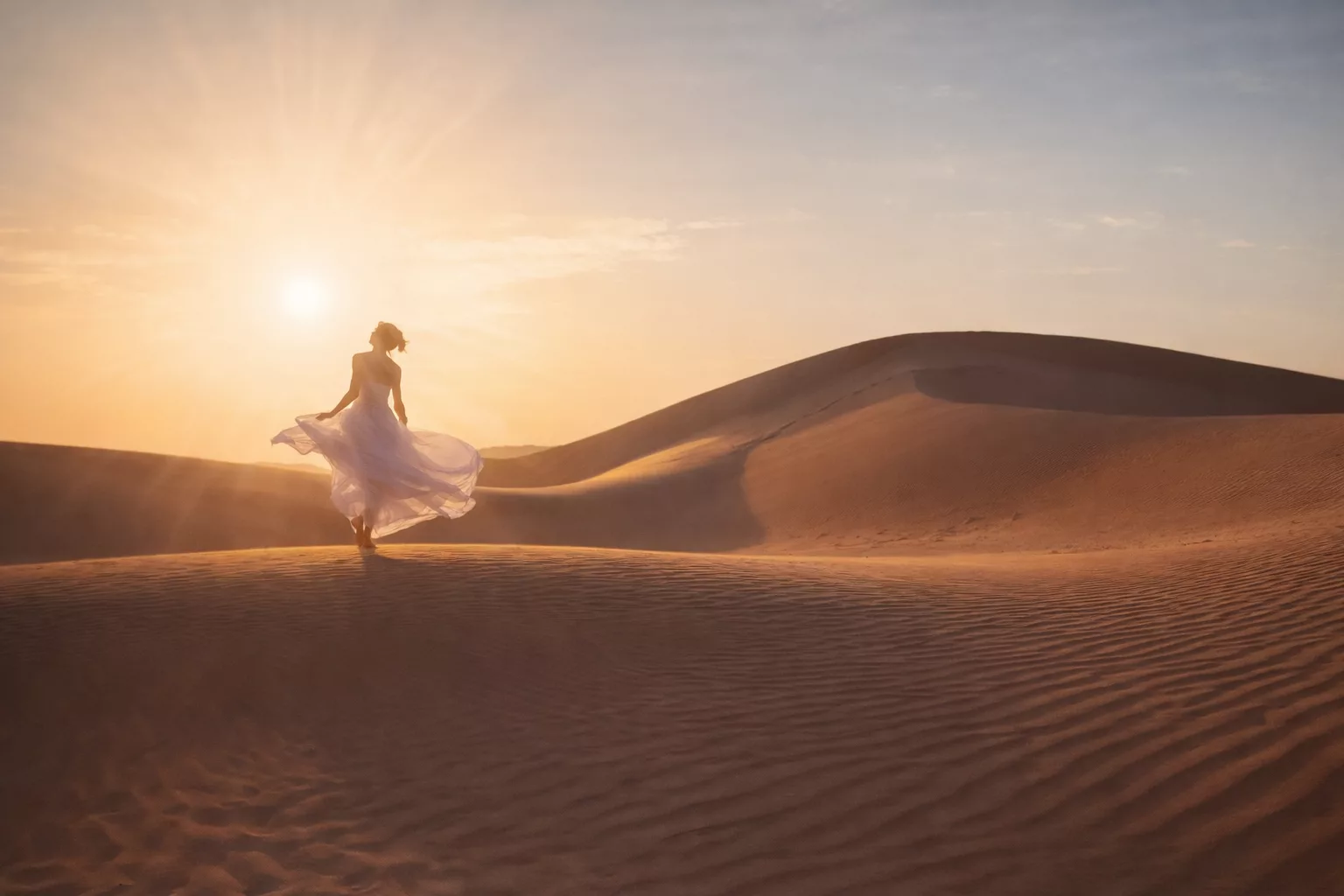
Morocco Has More Than One Desert Experience
Many travelers contact us and ask one question:
“Should I go to Merzouga or M’Hamid?”
This is a very good question because many websites speak about the Sahara as if it is one simple place. But Morocco has different desert gateways, different dune areas, different routes, different styles of camps, and different levels of authenticity.
Some travelers want famous dunes and comfort.
Some want silence and walking.
Some want a romantic camp.
Some want a real trek.
Some want photos.
Some want nomadic culture.
Some want a private journey away from crowds.
This is why the answer is not the same for everyone.
Merzouga and M’Hamid are both connected to the Moroccan Sahara, but they create different feelings. If you choose only from Instagram photos, you may not understand the difference. But when you have worked in Morocco travel, visited the regions, guided travelers, listened to their feedback, and built desert itineraries for different people, you begin to see clearly:
Merzouga is often the classic desert image. M’Hamid is often the deeper desert feeling.
Both can be beautiful. Both can be meaningful. But they are not for the same traveler.
As someone born in the desert and managing Morocco tours through DesertBrise Travel and Trek Desert Maroc, I believe travelers deserve honest advice before choosing. The desert is not only a product. It is a living place, and the way you enter it changes everything.
What Makes Merzouga Famous?
Merzouga is famous mainly because of Erg Chebbi, one of Morocco’s most photographed dune areas. The dunes are high, beautiful, and easy to recognize. For many travelers, this is exactly what they imagine when they think of the Sahara: golden sand, camel rides, sunset, desert camp, music around the fire, and sunrise over the dunes.
This is why Merzouga became very popular.
It is also easier to understand for travelers. You go to Merzouga, you reach the dunes, you sleep in a camp, and you return. Many tour agencies offer this route from Marrakech or Fes. There are many camps, many hotels, many activities, and many options for different budgets.
For a first desert experience, Merzouga can be impressive. The dunes are close, the views are strong, and travelers can get the “classic Sahara photo” without needing a long trek or deep expedition.
Merzouga is also practical for certain itineraries. It can work well when traveling between Marrakech and Fes, or when building a Morocco tour that includes Fes, the Middle Atlas, Ziz Valley, Erfoud, and the desert. For some travelers, this route makes sense.
But popularity also has another side.
Because Merzouga is famous, it can feel more commercial, especially in busy seasons. Some areas have many camps, many vehicles, many camel caravans, and many travelers following similar programs. This does not mean Merzouga is bad. It means the experience must be chosen carefully.
A private, well-designed Merzouga experience can still be beautiful. But travelers should understand that Merzouga is not always the quiet, remote Sahara they imagine. It depends on the camp, the route, the guide, the season, and the way the tour is organized.
What Makes M’Hamid Different?
M’Hamid has a different atmosphere.
M’Hamid is often described as the last village before the deep desert. When you arrive there, the feeling changes. The road reaches its limit, and the desert begins to open slowly. It does not feel like a place built only for visitors. It feels like a gateway to a wider, older, quieter Sahara.
For me, M’Hamid is not only a destination. It is a threshold.
From M’Hamid, travelers can begin real desert treks. The routes can pass through dunes, dry riverbeds, tamarisk trees, stone desert, open plains, nomadic areas, and remote camps. The landscape is not only one wall of dunes. It is more varied, more subtle, and often more powerful for travelers who want to understand the desert beyond photos.
M’Hamid is also connected to Erg Chigaga, one of the great dune areas of southern Morocco. Erg Chigaga feels wilder and more remote than Erg Chebbi because it takes more effort to reach. That distance is part of its beauty. You do not arrive instantly. You enter gradually.
This is why M’Hamid is especially strong for trekking.
A trek from M’Hamid is not only about reaching a dune. It is about the journey itself. The walking matters. The silence matters. The stops matter. The tea matters. The guide’s knowledge matters. The rhythm of the day matters.
Travelers who choose M’Hamid usually want something slower and deeper. They may not want the most famous photo. They want the real feeling of being in the Sahara.
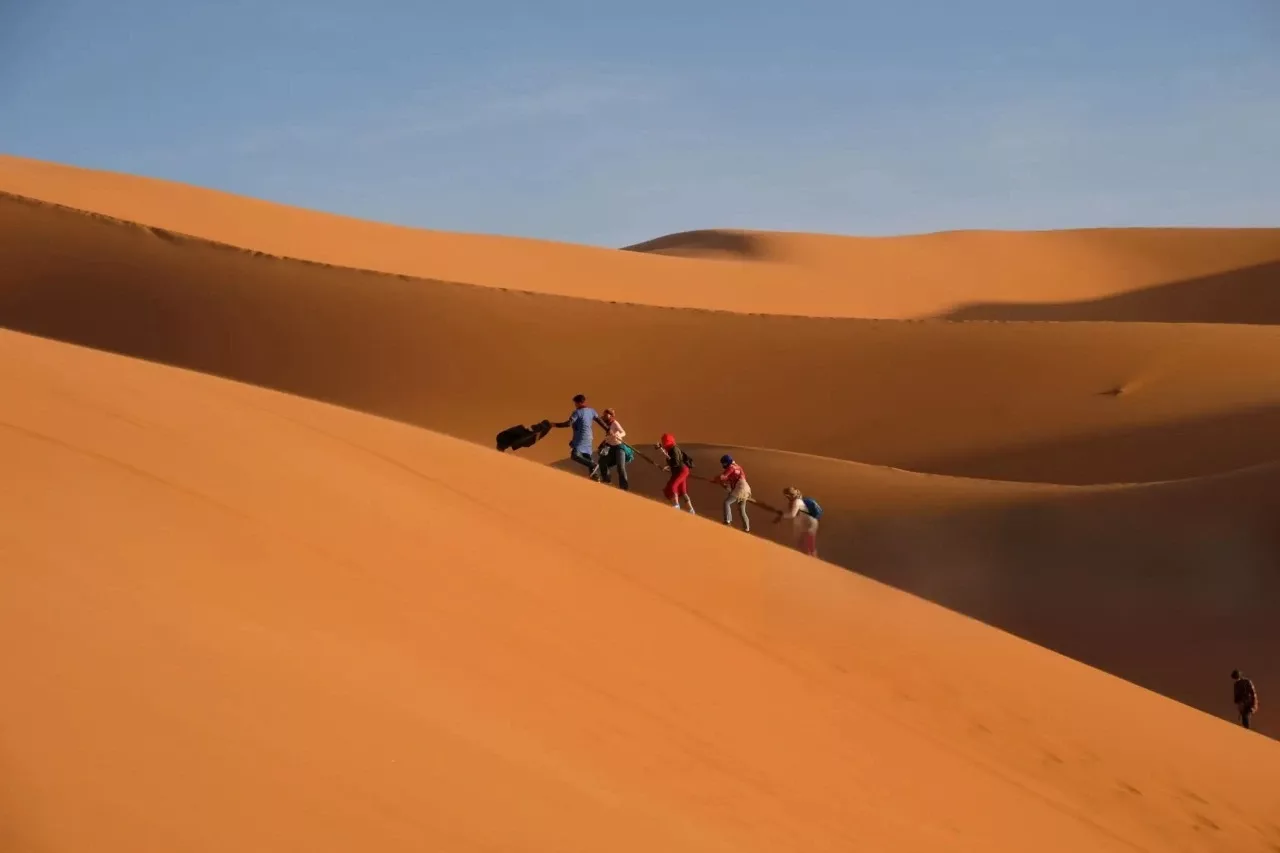
Desert Trek or Desert Camp: Know the Difference
Before comparing M’Hamid and Merzouga, travelers should understand one important difference:
A desert camp experience is not the same as a desert trek.
A desert camp experience usually means arriving by vehicle, riding camels for a short time, watching sunset, sleeping in tents, enjoying dinner, and returning the next day. This can be beautiful and comfortable, especially for travelers with limited time.
A desert trek is different.
A trek means walking. It means entering the desert with your body, not only with a car. It means feeling the sun, wind, sand, silence, and distance. It means the journey is not only the camp at night, but the whole rhythm from morning to evening.
In a real trek, the desert becomes more personal. You begin to notice details. You see animal tracks. You understand why guides choose certain paths. You feel why shade and water matter. You listen differently. You sleep differently. You appreciate simple food and tea differently.
For this kind of experience, M’Hamid is often stronger than Merzouga because it gives access to wider trekking routes and a deeper desert atmosphere.
This does not mean Merzouga has no trekking. But many Merzouga experiences are built around the camp-and-dune model, while M’Hamid naturally supports longer walking journeys, private treks, nomadic routes, and a slower way of entering the Sahara.
The Feeling of Merzouga
Merzouga feels visual.
The dunes are dramatic. The sand rises high. The sunset can be beautiful. The sunrise can be unforgettable. For photographers and first-time desert travelers, Erg Chebbi can feel powerful immediately.
This is the strength of Merzouga: it gives the desert image quickly.
Travelers who want a classic Morocco desert tour often enjoy Merzouga because it matches what they imagined before coming. A camel ride into the dunes, a camp, a fire, and the morning light over Erg Chebbi can create strong memories.
Merzouga can also work well for travelers who want more comfort. There are many camp levels, from simple to luxury. There are also hotels and guesthouses near the dunes, making it easier for people who do not want a very remote experience.
But the traveler should be aware of one thing:
Merzouga can sometimes feel busy.
In high season, the area can receive many visitors. Some camps are close to each other. Some routes feel repeated. Some experiences are designed more for quick tourism than deep connection.
The solution is not to reject Merzouga. The solution is to choose carefully. A good local operator can design a better Merzouga experience by selecting the right camp, avoiding the most crowded feeling, adding cultural stops, and building the itinerary with a good rhythm.
Merzouga is best for travelers who want beauty, dunes, comfort, and a classic Sahara experience without needing a long trek.
The Feeling of M’Hamid
M’Hamid feels slower.
It does not always impress the traveler in one second like high dunes can. Instead, it works more deeply. The landscape opens gradually. The silence becomes stronger. The horizon feels wide. The desert begins to feel less like a place to visit and more like a world to enter.
This is the beauty of M’Hamid.
Travelers who choose M’Hamid often say that the experience feels more real, more intimate, and less commercial. They may walk for several days, sleep in simple camps or bivouacs, share tea with guides, sit around the fire, and feel the desert without too many people around.
M’Hamid is especially good for:
-
real desert trekking
-
private Sahara journeys
-
Erg Chigaga tours
-
nomadic-style experiences
-
yoga and desert retreats
-
travelers looking for silence
-
people who want less commercial routes
-
photographers who want space and atmosphere
-
couples or small groups seeking privacy
In M’Hamid, the desert is not only a backdrop. It becomes the center of the journey.
For some travelers, this is exactly what they are looking for. For others, it may feel too simple or too remote. That is why honest advice matters.
The right desert is the one that matches the traveler’s expectations.
Erg Chebbi vs Erg Chigaga
When people compare Merzouga and M’Hamid, they are often really comparing Erg Chebbi and Erg Chigaga.
Erg Chebbi is near Merzouga. It is easier to access and very famous for its tall dunes. It is excellent for dramatic views, classic desert camps, and shorter itineraries.
Erg Chigaga is usually reached from M’Hamid. It is more remote and requires more effort. This makes it feel wilder, quieter, and more expansive. It is often better for travelers who want to feel distance and silence.
The difference is not only visual. It is emotional.
Erg Chebbi says:
“Here are the dunes. Look how beautiful they are.”
Erg Chigaga says:
“Enter slowly. Leave the road behind. Feel how wide the desert is.”
Both are beautiful, but they speak differently.
If a traveler has limited time and wants an easy classic desert experience, Erg Chebbi can be the right choice. If a traveler has more time and wants deeper desert atmosphere, Erg Chigaga can be stronger.
At DesertBrise Travel and Trek Desert Maroc, we help travelers choose based on the kind of experience they want, not only the name they saw online.
Which Is Better From Marrakech?
Many travelers begin from Marrakech, so this question is important.
From Marrakech, both Merzouga and M’Hamid require time. The journey crosses the High Atlas Mountains and southern Morocco, passing beautiful landscapes, kasbahs, valleys, and desert gateways. But the rhythm is different.
A Merzouga trip from Marrakech is common, but it can be long. Many travelers do it in 3 days, but this can feel rushed because the distances are big. A better Merzouga experience from Marrakech usually needs more time or a route that continues to Fes instead of returning the same way.
M’Hamid from Marrakech can also take time, but it works beautifully when the traveler wants to focus on the southern route: Atlas Mountains, Ait Ben Haddou, Ouarzazate, Draa Valley, Zagora, and then M’Hamid. This route feels like a natural descent into the desert.
For a real trek from Marrakech, M’Hamid is often a better choice because the journey leads directly toward walking routes and deeper desert experiences. Instead of only reaching a camp, the traveler can begin a trek and enter the Sahara with more meaning.
For travelers with only 2 or 3 days, expectations must be realistic. A quick desert trip can be done, but it will not feel the same as a real Sahara journey. For deeper experience, I usually recommend at least 4 or 5 days.
The desert should not be rushed. It gives more when you give it time.
Which Is Better From Fes?
From Fes, Merzouga often makes more sense logistically.
The route from Fes toward Merzouga passes through the Middle Atlas, cedar forests, Ziz Valley, Erfoud, and then the dunes of Erg Chebbi. This can be a beautiful journey and works well for travelers who want to connect Fes with the Sahara and then continue toward Marrakech.
M’Hamid from Fes is possible, but it usually requires more complex planning and longer travel time. It can be done in a custom itinerary, especially for travelers who want to avoid standard routes and go deeper south, but for many travelers starting in Fes, Merzouga is the more practical desert option.
This is why itinerary design matters.
There is no single answer without knowing the starting point, ending point, number of days, travel style, and purpose of the trip.
A traveler starting in Marrakech and wanting a real trek may be better with M’Hamid.
A traveler starting in Fes and wanting a classic desert route may be better with Merzouga.
A traveler with 10 or 12 days can include a more complete route with better balance.
Good Morocco travel planning is not about forcing one destination. It is about creating the right journey.
Which Is Better for Families?
For families, the best choice depends on the age of the children and the comfort level required.
Merzouga can be easier for families because there are more accommodation options, easier camp choices, and a more direct classic experience. Children often enjoy the dunes, camel ride, campfire, and sleeping in the desert. For families who want comfort and simplicity, Merzouga can work very well.
M’Hamid can also be excellent for families, especially adventurous families who want a private trek or a quieter desert experience. But it must be planned carefully. The walking distance, heat, camp comfort, meals, transport, and safety must all be adapted.
For families, I usually recommend private tours instead of shared group tours. Families need flexibility. Children may get tired. They may need stops. Parents may want more comfort. A private itinerary allows the rhythm to change.
The desert can be magical for children, but it should not be rushed or forced.
Whether the family chooses Merzouga or M’Hamid, the most important thing is honest planning.
Which Is Better for Couples?
For couples, both destinations can be beautiful, but they create different romantic feelings.
Merzouga offers the classic romantic image: dunes, sunset, camp, stars, and comfort. A well-chosen private luxury camp can be a beautiful experience for couples or honeymoon travelers.
M’Hamid offers a quieter, more intimate feeling. It is better for couples who want privacy, silence, simplicity, and a deeper connection with the desert. A private trek or private Erg Chigaga journey can feel very personal because the desert space is wider and less crowded.
For couples who want luxury and easy beauty, Merzouga may be enough.
For couples who want a deeper journey and more silence, M’Hamid may be stronger.
Again, the choice depends on the feeling you want.
Some couples want comfort and photography. Others want fire, stars, walking, and silence. Morocco can offer both, but the itinerary should be designed around the couple, not around a standard package.
Which Is Better for Yoga and Retreats?
For yoga, meditation, coaching, and retreat experiences, I strongly prefer the M’Hamid and Erg Chigaga region.
The reason is simple: retreats need space, silence, and rhythm. They should not feel like a tourist camp surrounded by too many people and vehicles. The desert should support the practice, not distract from it.
M’Hamid gives better access to remote-feeling areas, private camps, walking routes, sunrise practice, sunset silence, fire circles, and simple living. For small groups, it can be designed beautifully.
A desert retreat is not only about doing yoga in front of dunes. It is about using the desert environment as part of the transformation. Walking becomes meditation. Silence becomes teacher. Tea becomes ritual. Stars become reminder. Fire becomes gathering point.
This kind of experience needs careful local planning.
For DesertBrise Travel and Trek Desert Maroc, this is one of the most meaningful ways to share the Sahara: not as decoration, but as a real place of reset, simplicity, and connection.
Which Is Better for Photographers?
Photographers can enjoy both Merzouga and M’Hamid, but they will capture different moods.
Merzouga is excellent for strong dune shapes, sunrise, sunset, camel silhouettes, and classic Sahara images. If a photographer wants dramatic sand dunes with easy access, Erg Chebbi is powerful.
M’Hamid and Erg Chigaga are better for atmosphere, wide landscapes, remote feeling, nomadic scenes, trekking moments, camp life, fire, open horizons, and storytelling. The images may feel less “perfect postcard” and more documentary, human, and deep.
For professional or serious photographers, I often recommend more time. Photography in the desert depends on light, weather, wind, and patience. A rushed trip gives only one sunset and one sunrise. A deeper trip gives more chances and more real moments.
The best desert photography is not only about dunes. It is about life, movement, silence, people, animals, tracks, and the way light changes the land.
Which Is More Authentic?
This is a sensitive word because many companies use “authentic” too easily.
Authenticity does not come only from the destination. It comes from how the journey is organized.
You can have a commercial experience in M’Hamid if it is badly planned. You can have a meaningful experience in Merzouga if it is carefully designed. So we should be honest.
But in general, M’Hamid often gives travelers a stronger sense of authenticity because it is quieter, less saturated, and more connected to trekking routes and nomadic desert life. It feels less like a ready-made desert product and more like a real gateway.
Merzouga is more developed for tourism. This can be positive for comfort, but it can reduce the feeling of remoteness.
For travelers looking for the most authentic Sahara atmosphere, I usually recommend:
-
choose M’Hamid or Erg Chigaga
-
travel privately
-
avoid rushing
-
include walking
-
choose local guides
-
stay in smaller camps
-
allow time for silence
-
ask for cultural context, not only activities
Authenticity is not something you consume quickly. It appears when there is respect, time, and real connection.
The Biggest Mistake Travelers Make
The biggest mistake is choosing the desert only by a photo.
A high dune photo does not tell you how the journey feels. It does not tell you if the camp is crowded. It does not tell you how many hours you will sit in the car. It does not tell you if the guide is local. It does not tell you if the experience is rushed.
The second mistake is choosing only by price.
A very cheap desert tour may look attractive, but sometimes it means long drives, crowded transport, low-quality camps, forced stops, and little flexibility. The traveler saves money but loses the real experience.
The third mistake is trying to do too much in too little time.
Morocco is beautiful, but distances are real. The road to the desert is part of the journey, not just an obstacle. If you rush it, the desert becomes only one night in a busy itinerary.
The best desert experience begins with honest planning.
Ask yourself:
-
Do I want comfort or adventure?
-
Do I want a camp or a trek?
-
Do I want famous dunes or deeper silence?
-
Do I start from Marrakech or Fes?
-
How many days do I really have?
-
Do I want private travel or group travel?
-
Do I want photography, culture, romance, family comfort, or transformation?
When you answer these questions, the right desert becomes clearer.
My Honest Recommendation
Here is my honest recommendation as a local Morocco travel manager:
Choose Merzouga if you want a classic Sahara experience, high dunes, easier camp access, strong photos, and a route that works well between Fes and Marrakech.
Choose M’Hamid if you want a deeper desert feeling, real trekking, quiet routes, nomadic atmosphere, private journeys, Erg Chigaga, and a less commercial Sahara experience.
Choose Erg Chebbi if you want the most famous dune landscape.
Choose Erg Chigaga if you want more space, silence, and wild desert atmosphere.
Choose a desert tour if you want comfort and a shorter experience.
Choose a desert trek if you want to feel the Sahara slowly and deeply.
The best choice is not the most famous one. The best choice is the one that matches your rhythm.
How We Help Travelers Choose
At DesertBrise Travel and Trek Desert Maroc, we do not believe every traveler should receive the same desert itinerary.
Some travelers are perfect for Merzouga.
Some are perfect for M’Hamid.
Some need Erg Chigaga.
Some need a private 4x4 desert tour.
Some need a 5-day trek.
Some need a family-friendly route.
Some need a yoga retreat in silence.
Some need a full Morocco tour with cities, mountains, coast, and desert.
Our work is to listen first.
We ask about your dates, arrival city, departure city, travel style, comfort level, budget, interests, and the feeling you want from Morocco. Then we design the route with honest advice.
Because Morocco is not only about reaching places. It is about how the journey moves.
A good desert experience should feel natural. The road should prepare you. The guide should explain the land. The camp should match your expectations. The timing should avoid unnecessary pressure. The desert should have enough space to speak.
That is how we design our tours.
Final Thoughts: The Right Desert Is the One You Can Feel
M’Hamid and Merzouga are both part of Morocco’s desert story.
Merzouga gives the famous image: high dunes, camel ride, camp, sunrise.
M’Hamid gives the deeper entrance: silence, trekking, nomadic atmosphere, Erg Chigaga, and wider desert space.
One is not simply better than the other. But they are not the same.
For travelers who want a beautiful and easy first desert experience, Merzouga can be the right choice. For travelers who want a real Sahara trek, a quieter atmosphere, and a deeper connection to the desert, M’Hamid is often the stronger choice.
The Sahara is not only sand. It is time, silence, people, routes, wind, stars, and memory.
So before choosing, do not ask only:
“Which desert has better dunes?”
Ask:
“What kind of desert experience do I want to carry with me after I return home?”
That question will guide you better.
And when you are ready, DesertBrise Travel and Trek Desert Maroc can help you design the right private Morocco desert journey — from Marrakech, Fes, Casablanca, or any starting point — with the rhythm, honesty, and local knowledge that the Sahara deserves.