Why Timing Matters So Much in the Sahara
Many travelers think the desert is always the same.
Sand, sun, camels, dunes, camp, stars.
But the Sahara changes a lot depending on the season. The same route can feel peaceful in winter, warm and golden in spring, very hot in summer, and clear and beautiful in autumn. The experience depends not only on the place, but also on the time of year.
This is especially true for trekking.
A desert tour by 4x4 can be adapted more easily because travelers spend more time in the vehicle and camp. But a real desert trek means walking. You feel the weather directly. The sun, wind, night temperature, walking pace, shade, and water planning all matter.
As someone born in the desert and managing Morocco travel through DesertBrise Travel and Trek Desert Maroc, I always tell travelers this:
The Sahara is beautiful all year, but not every season is right for every type of experience.
The best time depends on what you want. A couple looking for a romantic camp may choose differently from a group planning a 5-day trek. A family with children needs different timing from a photographer. A yoga retreat needs a different rhythm from a fast desert tour.
The desert must be respected. When you choose the right season, the Sahara becomes generous. When you choose the wrong time without preparation, the journey can become difficult.
October: The Desert Begins to Breathe Again
October is one of the best months to begin the desert trekking season.
After the strong heat of summer, the Sahara starts to become more comfortable. The days are still warm, but the extreme summer pressure begins to disappear. The evenings become more pleasant, and travelers can enjoy walking, camp life, and sunset without feeling overwhelmed by heat.
October is especially good for travelers who want:
-
warm desert days
-
comfortable evenings
-
good walking conditions
-
private desert tours
-
M’Hamid treks
-
Erg Chigaga journeys
-
family trips after summer
-
photography with clear light
For many travelers, October offers a beautiful balance. It is warm enough to feel like desert, but not usually as intense as summer. The walking rhythm becomes possible again, especially with good timing in the morning and afternoon.
A desert trek in October should still be planned carefully. Midday can be hot, so guides may adjust the rhythm: walking earlier, resting during stronger sun, and continuing later when the light softens.
This is how the desert teaches you to move with nature, not against it.
November: One of the Best Months for Desert Trekking
November is one of my favorite months for Sahara trekking.
The weather is usually more comfortable for walking, the light is beautiful, and the rhythm of the desert feels calm. Days are warm but not usually too hot, and evenings begin to feel cooler. For travelers who want a real trek, November is often an excellent choice.
This month is good for:
-
4-day desert treks
-
5-day Sahara treks
-
private M’Hamid walking routes
-
Erg Chigaga journeys
-
couples
-
photographers
-
small groups
-
travelers who want silence and comfort
November also works well for longer Morocco tours that combine Marrakech, Atlas Mountains, kasbahs, desert, Fes, or the coast. The weather across the country is often easier for travel than summer.
For desert trekking, November gives the body a better rhythm. Travelers can walk without fighting extreme heat. Camp evenings are cooler but still comfortable with the right clothing. The sky can be clear, and the stars often feel very strong.
If someone asks me for a strong month for a real Sahara trek, November is always high on my list.
December and January: Excellent Walking, Cold Nights
December and January are very good for walking in the desert during the day, but travelers must be prepared for cold nights.
This is something many people do not expect. They imagine the Sahara as always hot. But winter nights in the desert can be cold, especially in open areas, simple camps, or bivouacs.
During the day, winter trekking can be beautiful. The sun is softer. Walking is easier. The air feels clear. The silence is strong. For travelers who do not like heat, winter can be one of the best times to experience the Sahara.
But you need warm clothes.
A winter desert trek should include:
-
warm jacket
-
layers
-
hat or scarf
-
warm socks
-
comfortable walking shoes
-
sleeping comfort appropriate to the camp style
-
realistic expectations about night temperature
For travelers who are prepared, winter can be magical.
The fire feels more meaningful. Tea feels better. Blankets matter. The stars feel sharp in the cold night. Morning light over the dunes can be unforgettable.
December and January are especially good for travelers who want walking, photography, silence, and deep desert atmosphere without heat.
But for travelers who hate cold nights, March or April may be better.
February: A Quiet and Powerful Month
February is often a very good month for desert trekking.
It still carries winter freshness, but the days may start to feel softer than January. The walking conditions are usually strong, and the desert can feel quiet and spacious.
February is good for:
-
real walking treks
-
private desert journeys
-
couples
-
photographers
-
travelers who want fewer crowds
-
yoga or reflection-based trips
-
deeper Sahara experiences
Like December and January, nights can still be cold, so warm clothing is important. But February often gives a beautiful balance between winter clarity and the slow return of warmer light.
For travelers who want to avoid hotter months and experience the Sahara in a calm way, February can be excellent.
In the desert, quiet months often feel more personal. The traveler has more space to listen, walk, and connect.
March: One of the Most Beautiful Months in Morocco
March is one of the best months for Morocco travel in general, and it is especially beautiful for desert trekking.
The weather becomes warmer, but usually not too hot. Days are comfortable, evenings are pleasant, and the landscapes between mountains, valleys, and desert can feel alive. For travelers combining Marrakech, Atlas Mountains, southern Morocco, and the Sahara, March is often an excellent choice.
March works very well for:
-
M’Hamid desert treks
-
Erg Chigaga private tours
-
4-day and 5-day Sahara journeys
-
family travel
-
couples
-
photography
-
yoga retreats
-
full Morocco tours
The walking rhythm in March can be very good. Travelers usually enjoy the balance between warmth and comfort. Nights are less cold than deep winter, but still fresh enough to sleep well.
For many travelers, March feels like the desert is welcoming them.
It is warm, but not aggressive. Bright, but not exhausting. Quiet, but alive.
If you are planning a real desert trek and want one of the safest choices for weather, March is a very strong month.
April: Warm, Beautiful, But Needs Smart Planning
April is also a beautiful month for desert travel, especially early and mid-April.
The weather becomes warmer, and many travelers enjoy the feeling of longer days and softer evenings. The Sahara can be stunning during this period, with golden light, good camp atmosphere, and strong visual beauty.
But as April advances, heat can increase. For trekking, the daily rhythm becomes important. Guides may plan earlier starts, longer rests during stronger sun, and more careful walking distances.
April is good for:
-
private desert tours
-
shorter to moderate treks
-
Erg Chigaga journeys
-
couples and families
-
photography
-
travelers who prefer warmer weather
-
desert camp experiences
For serious multi-day trekking, April can still work very well with proper planning. But travelers should be ready for warmer days and should follow guide advice about water, shade, and pace.
The desert in April is generous, but it asks for respect.
May: Possible, But Not Always Ideal for Trekking
May can be beautiful, but it becomes more sensitive for desert trekking.
The heat can rise, especially in deeper desert areas. Short desert tours may still be possible with careful timing, but multi-day walking treks need more caution. Some travelers can handle it, especially if they are used to heat, but it is not the best month for everyone.
If a traveler wants to visit the desert in May, I usually recommend:
-
private planning
-
shorter walking periods
-
early morning activities
-
comfortable camp
-
good vehicle support
-
realistic expectations
-
avoiding difficult long walking days
May can still work for a private desert tour, a comfortable camp experience, or a carefully adapted route. But for travelers dreaming of a deep multi-day trek, I would usually suggest October to April instead.
The desert is not only about possibility.
It is about quality of experience.
Summer: Usually Too Hot for Serious Desert Trekking
Summer in the Moroccan Sahara can be extremely hot.
For serious desert trekking, summer is usually not the right season. Walking for long hours in high heat can be uncomfortable and unsafe. The desert sun is powerful, and the body can become tired quickly.
This does not mean all desert travel stops completely, but the style must change.
In summer, if travelers still want a desert experience, it should be planned very carefully:
-
avoid long walking treks
-
travel with private transport
-
choose comfortable accommodation
-
move early morning or late afternoon
-
rest during the hottest hours
-
drink enough water
-
listen to local advice
-
avoid forcing unrealistic activities
For most travelers, I recommend choosing another season for a real trek.
The Sahara is not a place to challenge blindly. It is a place to respect. Summer is part of its nature, but not always the best time for visitors who want to walk and enjoy deeply.
If your dream is a real trekking experience, wait for autumn, winter, or spring.
September: The Return Toward Desert Season
September is a transition month.
Early September can still be hot, especially in the deep desert. Later September begins to feel better, depending on the year and conditions. It can be possible for private desert tours, but for trekking, I usually prefer late September or October onward.
September needs local judgment.
Some travelers may enjoy it if they are prepared for heat and choose the right rhythm. Others may find it still too warm. The route, camp, transport, and walking level matter.
If you are considering September, ask for honest advice based on your travel dates and the type of experience you want.
For serious trekking, October is usually safer and more comfortable.
Best Months for Real Desert Trekking
For real desert trekking, my strongest months are usually:
November
December
January
February
March
Early April
October is also very good, especially after the heat breaks.
These months give better walking conditions, stronger comfort, and a deeper rhythm. Winter nights can be cold, but with preparation, winter trekking can be beautiful.
For most travelers, I would say:
-
Best overall balance: March and November
-
Best for cool walking: December, January, February
-
Best for warm but comfortable feeling: October and April
-
Best for serious trekking: November to March
-
Best for retreats: November, February, March
-
Best for families: October, March, April
-
Best for photographers: November, December, January, February, March
There is no single perfect month for everyone.
But there is a perfect rhythm for each traveler.
Best Time for M’Hamid Desert Treks
M’Hamid is excellent for trekking because it is a real gateway to the Sahara. But timing is important.
For M’Hamid treks, I usually recommend October to April, with November to March being especially strong.
The region offers many types of routes: dunes, dry riverbeds, tamarisk areas, stone desert, open plains, and paths toward Erg Chigaga. Because travelers may walk for several hours per day, cooler weather makes the experience much better.
In winter, M’Hamid treks can be peaceful and powerful. In spring, they can feel warm and beautiful. In autumn, the desert begins to open again after summer.
M’Hamid is not only about reaching one dune. It is about entering the desert gradually.
That kind of journey needs the right season.
Best Time for Erg Chigaga
Erg Chigaga is more remote and needs careful planning.
The best time for Erg Chigaga journeys is usually October to April. For trekking or deeper immersion, November to March is especially good.
Because Erg Chigaga is wilder and more spacious, travelers should respect distance, weather, and logistics. A private 4x4 journey can be adapted more easily than a walking trek, but both need good timing.
Erg Chigaga is powerful because it feels wide and less commercial. The silence is part of the value. But in hot months, that same openness can become difficult.
Choose Erg Chigaga when the weather allows you to enjoy the space, not fight it.
Best Time for Merzouga and Erg Chebbi
Merzouga and Erg Chebbi are famous for high dunes and classic desert camp experiences.
The best time is also generally October to April. Because many Merzouga experiences are camp-based and less walking-focused, some travelers visit outside the main trekking season. But for comfort, the cooler months are still better.
Merzouga works well in routes between Fes and Marrakech, especially when travelers want famous dunes, camel rides, camp nights, and dramatic sunrise or sunset views.
For trekking or longer outdoor activities, avoid strong summer heat.
Merzouga can be beautiful, but like every desert region, it should be experienced at the right pace and season.
Best Time for Families
For families, I recommend October, November, March, and April.
These months usually offer a good balance between comfort and beauty. Children can enjoy the desert without extreme cold nights or extreme heat. The experience can include camels, campfire, sand play, short walks, stars, and private family rhythm.
Winter can also work for families, but parents should be prepared for cold nights and bring warm clothing.
For families, the itinerary should be private and flexible. Children may need rest, shorter drives, simpler explanations, and adapted walking time. The best season is not only about weather. It is also about making the journey comfortable for everyone.
A family desert trip should feel magical, not exhausting.
Best Time for Couples and Honeymoons
For couples, the best months are usually October, November, February, March, and April.
These months offer beautiful light, comfortable days, and romantic evenings. A private desert camp, Erg Chigaga journey, M’Hamid trek, or luxury desert tour can feel very special during this period.
Winter can also be romantic, especially around the fire and under clear skies, but couples should be ready for cold nights.
For honeymoons, I often recommend a slower itinerary: Marrakech, Atlas Mountains, kasbahs, desert, and maybe Essaouira or Fes depending on time. The desert should not be rushed. Privacy and rhythm matter more than adding too many places.
The Sahara is romantic when there is space.
Choose a season that gives you comfort and silence.
Best Time for Yoga Retreats and Transformational Desert Journeys
For yoga retreats, meditation, coaching, and deeper desert journeys, I recommend November, February, March, and early April.
Retreats need stable rhythm. Not too hot, not too rushed, not too crowded. The desert should support the practice, not make the group uncomfortable.
M’Hamid and Erg Chigaga are especially strong for this type of experience because they offer silence, space, private camp possibilities, walking routes, and natural simplicity.
A desert retreat can include sunrise practice, walking meditation, tea rituals, fire circles, stargazing, local cultural exchange, and quiet time.
The best season for this is when the body can relax and the mind can slow down.
Extreme heat is not useful for this.
Cold nights can be powerful, but only with the right camp setup.
Best Time for Photography
For photography, the desert can be beautiful in many seasons, but cooler months give more comfort and more time outside.
November to March is excellent because the light is often clear, walking is easier, and sunrise and sunset can be powerful. Winter skies can feel very sharp. Spring light can be softer and warmer.
Photographers should avoid rushed one-night trips if possible. Desert photography needs patience. Wind changes the dunes. Clouds change the sky. People, camels, fire, tea, and walking moments happen naturally when the itinerary has time.
If you want real storytelling images, choose a trek or slow private journey.
The best photos often come when the trip is not forced.
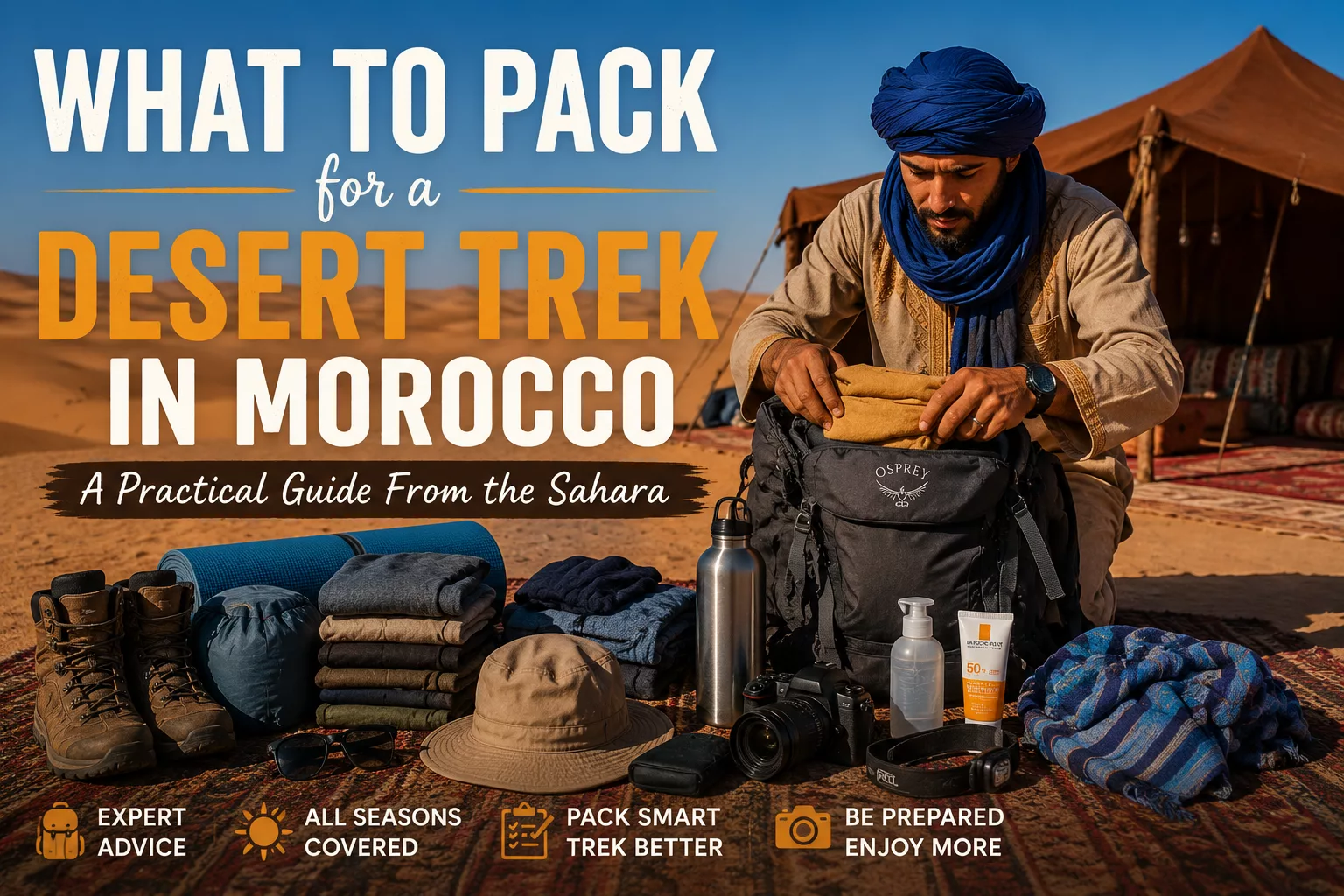
What to Pack by Season
Packing depends on the month, but some rules are useful.
For autumn and spring:
-
light walking clothes
-
sun protection
-
scarf or turban-style head covering
-
sunglasses
-
comfortable walking shoes
-
light jacket for evening
-
refillable water bottle
-
camera or phone protection from sand
For winter:
-
warm jacket
-
layers
-
warm socks
-
hat
-
gloves if you feel cold easily
-
comfortable sleeping clothes
-
scarf
-
good walking shoes
For warmer months:
-
very light breathable clothing
-
strong sun protection
-
hat or scarf
-
sunglasses
-
electrolyte support if needed
-
careful hydration
-
avoid unnecessary long walking
A good local company should advise you before arrival based on your exact dates and itinerary.
The desert is simple, but preparation matters.
My Honest Recommendation
Here is my honest advice:
Choose October to April for Morocco desert trekking.
Choose November or March if you want one of the best overall balances.
Choose December, January, or February if you prefer cooler walking and do not mind cold nights.
Choose April if you want warmer weather, but plan the trek carefully.
Avoid summer for serious multi-day walking treks unless the itinerary is very adapted and you understand the heat.
Choose M’Hamid or Erg Chigaga if you want deeper desert atmosphere and quieter routes.
Choose Merzouga if you want famous dunes and a classic desert camp experience.
Choose private planning if you want comfort, rhythm, and honest seasonal advice.
The best time for a desert trek is not only about the calendar.
It is about matching the season to the experience you want.
How We Help Travelers Choose the Right Season
At DesertBrise Travel and Trek Desert Maroc, we do not recommend the same desert experience for every month.
We look at your dates, starting city, number of days, comfort level, walking ability, group type, and the kind of Sahara experience you want.
Then we help you decide:
-
whether it is a good time for trekking
-
whether a private tour is better
-
whether M’Hamid, Erg Chigaga, or Merzouga fits your plan
-
how many days you need
-
what to pack
-
how to pace the journey
-
whether the route should be adapted for weather
Our goal is not only to take you to the desert.
Our goal is to help you experience it at the right rhythm.
Because the Sahara is powerful, but it must be approached with respect.
Final Thoughts: The Desert Has Seasons, and Each One Speaks Differently
The Moroccan Sahara is not the same every month.
In autumn, it opens again after summer.
In winter, it becomes clear, quiet, and strong.
In spring, it becomes warm, beautiful, and alive.
In summer, it becomes intense and demanding.
Each season has its own voice.
The question is not only:
“When can I visit the desert?”
The better question is:
“When can I experience the desert in the way I truly want?”
If you want a real trek, choose the cooler months.
If you want comfort, choose the right camp and route.
If you want photography, give yourself time.
If you want a family trip, choose gentle weather.
If you want silence and transformation, choose a season that lets you slow down.
The Sahara is not only a place to see.
It is a place to enter with the right timing.
DesertBrise Travel and Trek Desert Maroc design private Morocco desert treks, M’Hamid walking journeys, Erg Chigaga tours, Merzouga routes, family desert trips, couples experiences, yoga retreats, and custom Sahara itineraries based on honest local knowledge, seasonal advice, and the right rhythm.